
Universe life gigantically shortened! But you'll still have time to read this.

A year ago this week, three Dutch researchers calmly told us the universe will die gigantically sooner than we thought. We're still here. Just.
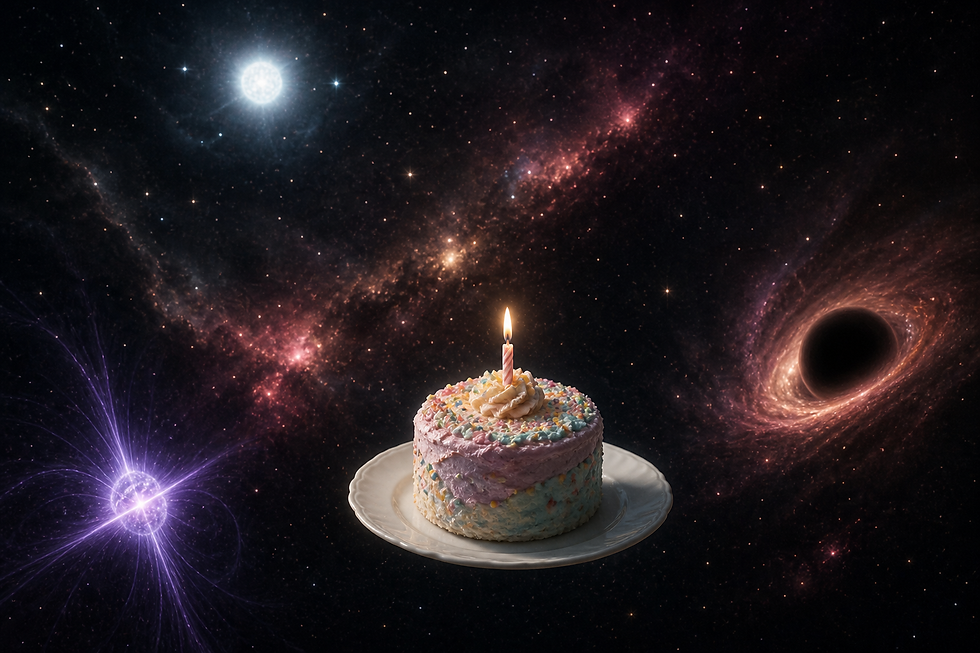
Happy first birthday, doomsday paper.
12 May 2025.
A trio of researchers at Radboud University in the Netherlands quietly published a paper in the Journal of Cosmology and Astroparticle Physics.
Its title, An upper limit to the lifetime of stellar remnants from gravitational pair production, was not exactly destined for the front page of the Daily Mail.
But the punchline absolutely was.
By their calculations, the universe is going to die sooner than we thought.
A lot sooner.
As in 'might live only a minuscule fraction of the time we thought it would' sooner.
A year on from the original publication, the paper has just clicked over to its first birthday. So has every star, planet, neutron star and white dwarf in existence. Except now they're all on a much tighter schedule.
You're welcome.
Give it to me straight doc. How long have we got, exactly?
The old number for the lifespan of the longest-lived stellar remnants — white dwarfs eventually decaying to black dwarfs — was 10¹¹⁰⁰ years.
A 1 followed by 1,100 zeroes. You could write it on an A4 page, but it is so mind-stumpingly large a number it's basically meaningless.
The new number, courtesy of Heino Falcke, Michael Wondrak and Walter van Suijlekom, is 10⁷⁸ years.
A 1 followed by "only" 78 zeroes.
So the new lifespan of the universe isn't one tenth of what we thought we had.
Not one hundredth.
Not one thousandth.
It's one 10¹⁰²² th.
That is a vanishingly small fraction of the time we thought the universe had left. If the old life of the universe was a year, the new lifespan would be a microscopic super-sliver of a second too short to ever measure.
"So the ultimate end of the universe comes much sooner than expected." — Heino Falcke, lead author, Radboud University.
For some context, the universe is currently around 13.8 billion years old, which is about 10¹⁰ years.
The new expiry date is still 10⁶⁸ times the universe's current age.
So yeah, I’d still hand in my next tax return.
Why the early checkout?
It comes down to a brilliant bit of work the same Dutch trio published in Physical Review Letters back in 2023.
Stephen Hawking famously argued in 1975 that black holes aren't quite as black as we'd thought. They very, very slowly emit radiation, lose mass, and eventually evaporate into nothing.
This Hawking radiation flies in the face of classical general relativity, which says black holes can only get bigger.
What Falcke, Wondrak and van Suijlekom did in 2023 was show that you don't actually need a black hole for the trick to work. Anything with a gravitational field — a neutron star, a white dwarf, the Moon, your nan — can in principle radiate the same way.
"We demonstrate that, in addition to the well-known Hawking radiation, there is also a new form of radiation." — Michael Wondrak, Radboud University.
There's a subtler point worth noting. The old 10¹¹⁰⁰ figure assumed protons themselves are essentially stable, or decay so slowly it barely matters. The Dutch trio's insight is that you don't need protons to decay for matter to vanish. Gravity gets there first. Spacetime itself slowly unmakes everything that has mass.
It is worth stressing, this is bleeding-edge stuff, not settled physics. Other researchers have published formal critiques arguing the maths might not hold up under closer inspection. The Dutch trio have replied. The conversation continues, as good science does.
The 2025 paper is the trio doing the maths on what that means for the dead stars left behind — neutron stars and white dwarfs, modelled as nice, simple, non-rotating spheres.
Spoiler: they all evaporate.
And how exactly does the universe end?
Glad you asked.
The Falcke paper isn't really about the universe going bang or poof. It's about everything in it gradually evaporating into pure radiation.
In the standard cosmic timeline, stars eventually burn out. Most of them, our Sun included, settle down as white dwarfs. The rest collapse into neutron stars or black holes. Once star formation winds down — somewhere around 10¹⁴ years from now — what's left in the universe is mostly compact remnants slowly cooling in the dark.
Btw, in case you're wondering — humans, even most life on Earth, will be long gone before any of this is an issue. About a billion years from now, the Sun will have brightened enough to trigger a runaway greenhouse effect on Earth. The oceans boil. The atmosphere thickens with water vapour. Surface temperatures climb past anything a mammal can tolerate. Earth quietly becomes a second Venus. That's 10⁹ years from now. Compared to 10⁷⁸ years, it's basically tomorrow.
The old assumption was that the white dwarfs and neutron stars would essentially sit there forever, or near enough — for something like 10¹¹⁰⁰ years. Black holes were on a faster timeline — Hawking radiation would finish a stellar-mass black hole in around 10⁶⁷ years.
What the Dutch trio showed in 2023, and quantified in 2025, is that the white dwarfs and neutron stars don't get to sit around either. They're radiating away too, just from the curvature of spacetime around them.
Counterintuitively, denser objects evaporate faster. So neutron stars vanish in about 10⁶⁸ years — roughly the same time it takes a stellar-mass black hole to evaporate via classic Hawking radiation. White dwarfs, less dense, hang on much longer. They are the marathoners of cosmic decay. The last to leave the dancefloor, taking the full 10⁷⁸ years to disappear.
By that point, the last ordinary stellar remnants are gone. There may still be some supermassive black holes hanging on for a while longer, but the era of "stuff existing as objects" is done.
What's left is something close to a final cold, dark, featureless soup. Photons and stray particles drifting forever in a space too empty to call empty.
Strictly speaking, some physicists might be grinding their gears here, thinking "Adam, the universe can continue to exist beyond the evaporation of all matter, as an eternally expanding vacuum." Fair point. But I reckon we can agree that once all matter has evaporated, the house lights have well and truly come on and the party is over.
"They reabsorb some of their own radiation, which inhibits the process." — Michael Wondrak, on why black holes don't evaporate faster than less massive objects.
That's right — black holes have a stronger gravitational field, but their event horizon swallows some of the radiation they emit before it can escape. Gravity giveth and gravity taketh away.
Don't cancel your weekend.
About 97 per cent of the stars in the Milky Way, our own Sun included, are destined to end up as white dwarfs.
Under the old physics, those white dwarfs would essentially sit there, slowly cooling toward 10¹¹⁰⁰ years.
Under the new physics, they're quietly shedding mass to what the authors call gravitational pair production the whole time.
After 10⁷⁸ years, gone.

Same fate. Much earlier flight.
"Fortunately, it still takes a very long time." — Heino Falcke, lead author.
That, right there, is the most reassuring quote ever delivered by a man who just told you everything is dying.
Cosmic perspective.
A year on from the doomsday paper, here we are.
Stars still shining. White dwarfs still being white dwarfy. Universe ticking along about 0.00000000000000000000000000000000000000000000000000000000000000000001 per cent of the way through its newly shortened life.
The big lesson isn't really about death dates. It's that we're still figuring out the rules.
Hawking pulled a thread in 1975. Three researchers in Nijmegen pulled it harder in 2023. They tugged again in 2025.
And every time someone pulls, the universe gets a little stranger and a little more interesting.
I'll happily take that trade.
Even if it costs me 1,022 zeroes.
Hey, I'm also on Substack.
References;
An upper limit to the lifetime of stellar remnants from gravitational pair production Falcke, Wondrak & van Suijlekom, Journal of Cosmology and Astroparticle Physics, 12 May 2025
Gravitational Pair Production and Black Hole Evaporation Wondrak, van Suijlekom & Falcke, Physical Review Letters, 2 June 2023
Universe decays faster than thought, but still takes a long time Radboud University press release, May 2025
The sun won't die for 5 billion years, so why do humans have only 1 billion years left on Earth? The Conversation, January 2025



Comments