
There’s a new shape in town!

A researcher dreamt up an eight-faced shape with three holes, where every face touches every other face. Now he has the numbers to prove it’s real.

The shape of new.
Ok just when you thought maths couldn’t confuse you more get this. A maths nerd has just discovered a new shape!
A. New. Shape! WTF?
If I told you we had gained some deep new insight about prime numbers ok. Some malarkey about travelling through a seven-dimensional universe; fine Spence, I’ll let you have that.
But surely in 2026, we had shapes sorted? It turns out we haven’t.
Touching face.
Let’s unpack what is going down here.
Start with a good old-fashioned triangular pyramid. Think of a four-sided dice. I know it as a tetrahedron but that is not important here. What matters is that it has four faces, and every single one of them shares an edge with the other three. No face is left out.
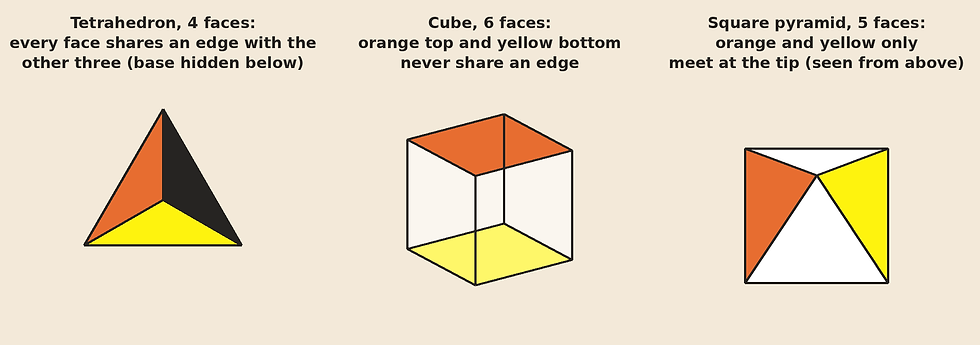
Now try that for a shape with five faces. Or six. It can’t be done on an ordinary solid, because some pair of faces always ends up on opposite sides with no edge between them. Think of the opposite sides of a cube that just can’t find an edge to meet upon.
Set your time machines for 1977 and cue a Hungarian mathematician, Lajos Szilassi. The L-Dog punched a hole through this problem. Quite literally. He discovered a shape that has seven, count them, seven faces, each with six sides, wrapped around a hole in the middle. Think of it as a sharply angled doughnut, where once again every face meets every other face along an edge.

And for more than 40 years, that was it. The tetrahedron and the Szilassi polyhedron were the only ones we knew where every pair of faces met along exactly one edge.
One hole good, three holes better.
Spin the time machine dial forward to 2020 and queue Ruslan Mizhaev. More an independent researcher and design engineer than a professional mathematician, old Ruslan wasn’t attempting to improve upon the Szilassi polyhedron. He was simply messing about with surfaces in design software, when he noticed what he’d suddenly achieved.
And what had he done?
He’d found a shape with eight faces, each of them with nine sides. It contains twenty-four corners, thirty-six edges, three faces meeting at every corner. And not one, not two, but three holes running through it.
“There are eight flat, polygonal faces, and each is a neighbour of all seven others along an edge. Together, they form a closed surface with three handles.” — Ruslan Mizhaev.
Note this shape is not a direct advance on the Szilassi polyhedron in that with eight faces some pairs have to share two edges rather than one.
But it’s one more object that exists in the world and that in itself is a gorgeous thing.
Hold it .. . handles? This shape has handles?
Another example of the ability of mathematicians to confuse us without even trying.
When we say handles, think holes.
When mathematicians are looking at a range of shapes, one of the ways they compare them is the number of holes they might have. A ball (sphere) has no holes. Nor does a solid pyramid or a cube. A doughnut has one, a figure eight has two. Mizhaev’s shape has three.
Szilassi’s shape can be thought of as a (very sharp edged and nasty on the teeth) doughnut. In some ways Mizhaev’s is closer to a pretzel.
Knowing ain’t building.
But Mizhaev wasn’t done in 2020. You see, it turns out with shapes as complicated as this, proving they exist and being able to draw or construct them are two very separate things.
While you can number the faces and say which ones are meant to meet on the back of an envelope, actually constructing the shape, building it in three dimensions, is brutally harder.
“I can tell you these are the rules. But when I try to build it and I try to draw it, I can’t do it.” — Lars Schewe, University of Edinburgh.
Why so hard?
Every face has to be properly flat. The whole surface has to close up with no gaps, and no part of it can slice through any other part.
And the cahllenge is that there’s no reliable method for getting there. Yes, you can write out an enormous pile of equations describing where every corner could possibly sit, but that becomes impossible to solve in practice. So people fall back on a combination of computer searches, gut instinct and physical models.
In 2020 Mizhaev built this shape in the popular computer aided design software platfrom CAD. It looked almost certain to exist. But CAD works in approximations, so it can’t guarantee that every face is absolutely flat, or that no two faces pass through each other in some obscure, hard to spot way.
That’s where exact whole numbers come in. And that’s what Mizhaev achieved just last month. His new paper pins all 24 corners to whole-number coordinates, with equations anyone can run to check. It’s posted on arXiv, the preprint site, so strictly it’s not yet peer reviewed, but with precise numbers like this, if there was a mistake, you’d expect it to be found pretty quickly.
No granny flats.
Now, let me be perfectly clear. No one’s about to build you a granny flat in this shape. You’re not going to see it in an aircraft engine or play with one on your desk. That’s not the point here.
The branch of mathematics known as pure mathematics does a lot of discovery for the sake of discovery. Blue sky thinking. Deep thinking about the nature of what shapes are possible, the geometry they would have, how they would fit into our three-dimensional universe, often gives us crucial insights into far more practical, in some ways more mundane, matters. This is about far more the glory of the chase than the practicality of the shape.
Where to now?
There is a beautiful piece of mathematics from the greatest of them all, Leonhard Euler that suggests there could be a twelve-faced, six-holed shape out there with every pair of faces sharing exactly one common edge. Perhaps the next shape in the sequence, after the tetrahedron and Szilassi polyhedron.
If you’ve got nothing better to do …
Further Reading:
Mizhaev, R. “Integer Realization of an Equivelar Octahedron of Genus 3”. arXiv, 2026. https://arxiv.org/abs/2609.17700
Stokel-Walker, C. “Mathematician discovers rare eight-faced shape”. New Scientist, 2026.
“Szilassi polyhedron”. Wikipedia. https://en.wikipedia.org/wiki/Szilassi_polyhedron
Ace, T. “Szilassi polyhedron”. The Geometry Junkyard, 1996. https://ics.uci.edu/~eppstein/junkyard/szilassi.html


Comments