What if cancer’s bark was worse than its bite?

Updated: Apr 11
Aussie dog‑dad and awesome geek turns to AI, genomics and mRNA vaccines to fight his rescue dog’s “months to live” cancer.
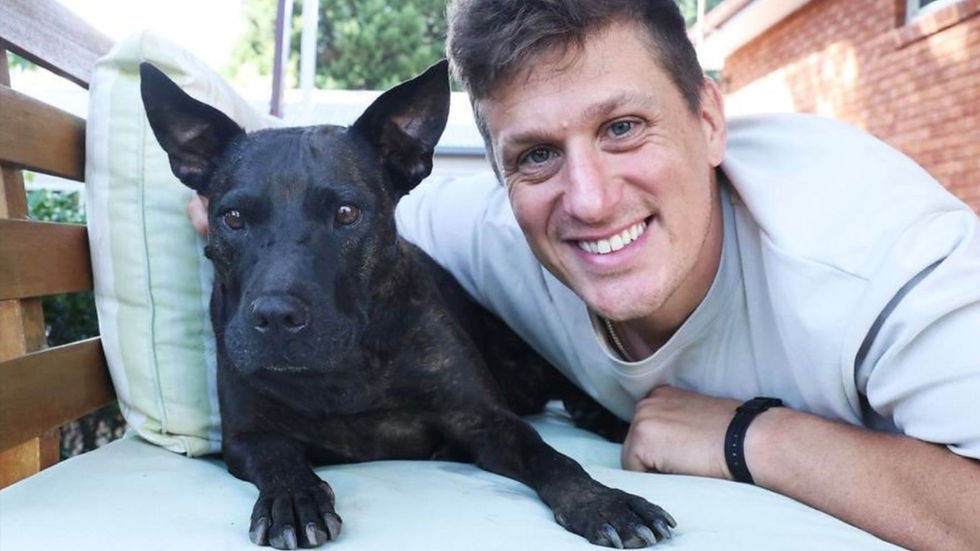
This rescue dog’s AI‑designed cancer vax hints at a future of personalised human medicine.
Confession of a non-dog owner.
Full disclosure: I’ve never owned a dog. I know lots of people who have. So, while I’ve never experienced the emotional pull of “I’d do anything for my dog”, I’ve witnessed it often enough to think I’ve got a feel for it.
Well one Aussie geek is making world news by taking “anything” to an entirely new level.
Sit, stay… terminal cancer?
One day tech entrepreneur Paul Conyngham finds a lump on his staffy-cross Rosie. Then another. Then too many to count. The eventual diagnosis is an aggressive, incurable cancer. “Months to live” stuff.
Most of us would be floored. In 2022 you’d just give up. Or perhaps Google “miracle cancer cure for dogs” and cross your fingers.
According to Paul, Rosie was misdiagnosed on three occasions, which only added to the sense that the usual system wasn’t going to save her.
But it’s 2026. So Paul dug in.
“One of the tumours had gotten so large that it wrapped around her leg, there was just not enough skin to close it. That’s when I realised we needed to try different options” Paul Conyngham TBPN Podcast
Using his tech background and off‑the‑shelf AI tools, he started mapping the genetic “fingerprint” of Rosie’s tumour, using ChatGPT to help work out what to sequence and what to do with that data.
With UNSW scientists and a specialist lab in his corner, within two months, Paul had design a personalised mRNA vaccine for Rosie. A treatment that could identify cancer cells and take them out.
This wasn’t a stock cancer drug off a shelf. It was built for one dog, and one dog only.
Hey mRNA, that’s the Covid vaccine yeah?
You may well have heard of mRNA vaccines since mid‑2022. While some people have some issues with some aspects of the pandemic, those in the vaccine biz think mRNA vaccines are the future.
Traditional vaccines use weakened or chopped‑up germs to train your immune system. mRNA vaccines use tiny genetic instructions so your cells briefly make a harmless piece of the germ, again galvanising your immune system to fight the illness.
They promise treatment that is faster to design, easier to update, and potentially highly personalised to each disease. In the case of cancer even perhaps to each patient.
Fetch the results.
Then came the bit every concerned carer knows all too well: the waiting.
Rosie had the vaccine. Her tumours were scanned. Everyone held their breath.
Over the following weeks, something incredible happened.
Many of the tumours shrank dramatically, some by more than half. At the time of writing, Rosie has gone from “months to live” to “still here, still wagging”.

Not every lump disappeared. One big, stubborn tumour basically bared its teeth and refused to budge.
Heel, bad tumour.
That one uncooperative tumour is now the star of the sequel.
Rosie’s devoted dog‑dad is working with UNSW scientists on a second vaccine, this time targeted at the lump that ignored round one.
The team has started fresh genetic sequencing to figure out what makes this rogue outlier different, and whether another custom jab can bring it to heel.
Some scientists reckon that for some cancers we might be able to downgrade the sentence from “terminal” to “manageable”, by getting in ahead of the mutations instead of chasing them.
What did the AI actually do?
AI in Rosie’s story was a very clever assistant, not a miracle doctor.
According to his interviews, Paul used ChatGPT to plan the workflow, AlphaFold to analyse the tumour mutations, and a Grok model in the final design step – on top of paying about $3,000 to have Rosie’s healthy and tumour DNA sequenced at UNSW’s Ramaciotti Centre for Genomics in Sydney.
It helped him sketch out the plan, decide what to sequence, which tools to run, how to line the steps up, and then chew through the data to spot promising mutations and vaccine targets.
“We took her tumour; we sequenced the DNA; we converted it from tissue to data; we used that to find the problem in her DNA and developed a cure based off that.” Paul Conyngham, Today Show Channel 9.
Could we have done this pre‑ChatGPT? Yes. In big cancer centres similar pipelines already exist. But they belonged to teams of bioinformaticians and oncologists.
The stunning part of this story is that it was a single, motivated dog‑dad being able to ride those ideas from his laptop.
Paws for a reality check.
Rosie’s vaccine hasn’t been written up in a medical journal yet. It’s a spectacular story, but a N‑of‑1 sample size.
But it’s riding on top of real, peer‑reviewed mRNA cancer vaccine work in both dogs and humans.
In dogs, early trials say these mRNA cancer jabs can rev up the immune system safely and may buy extra time even in some properly nasty cancers.
On the human side, personalised mRNA vaccines built from a patient’s own tumour mutations are in early‑stage trials, including an Australian study for children with deadly brain tumours.
“We can do this here. We can democratise this technology in Australia. And we can also use it for other diseases. Neurological diseases for instance,” Professor Pall Thordarson UNSW.
Don’t panic cancer doc. Your job is safe for now.
So quick reality check before we all start asking chatbots to monster our moles.
This wasn’t ChatGPT magically inventing a miracle drug while Paul made a cuppa.
It was serious science, tight collaboration with UNSW, careful lab work, eye‑watering bills, and one dog who happened to have a very determined human.
We don’t yet know how many Rosies this approach will help, or how quickly anything like it might reach humans.
But even with the hype dialled down…
This is still astonishing.
We’re watching the early days of medicine that behaves more like software. Scan the problem, push a personalised patch, update again when the bug mutates.
Today it’s one much‑loved rescue dog whose life just got a surprise extension.
Tomorrow it might be the standard playbook for keeping all of us, and our best mates, around for a few more belly rubs.
Hey I'm now also on substack.


I found this article both interesting and a bit thought-provoking, especially the part where it discussed how early detection and emerging treatment approaches can significantly influence outcomes in dogs with cancer. It’s reassuring to see progress being made, but it also makes me wonder how accessible these treatments really are for everyday pet owners. In a way, reading this reminded me how people often juggle different responsibilities like when I came across the phrase “Unlock excellence with Australian assignment help services delivering expert guidance, plagiarism free solutions, timely submissions, and high distinction results, empowering students to succeed confidently across universities with trusted professionals support..” randomly elsewhere it highlights how varied life concerns can be. Overall, the article gives hope but…