
Australian science’s night of nights.

The annual Eureka Prizes have been run, and won, by some awesome Aussie scientists. NerdNews profiles a few.

A quantum leap for Aussie science.
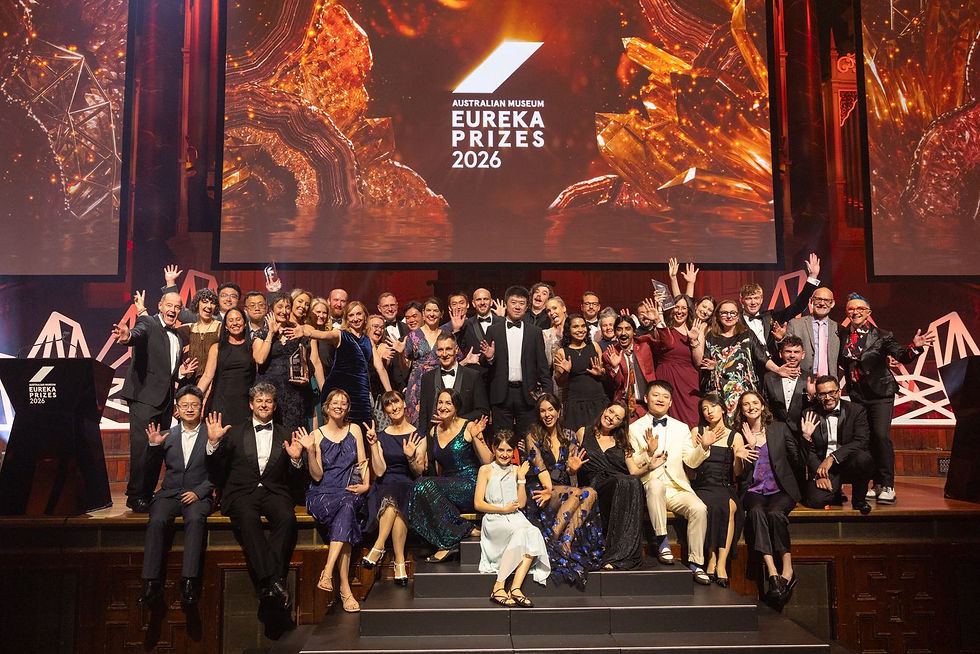
Australia’s geek community came out in style last Thursday night as Sydney Town Hall played host to one of my favourite events on the calendar: the Australian Museum Eureka Prizes, celebrating great moments and humans in Australian science.
For more than 20 years, I’ve been honoured to be one of the MCs of this wonderfully nerdy night.
The 2026 prize winners’ work spanned everything from melanoma treatment and forensic science to defence technology and teenage science communication. Rather than attempt to cram all of that into one NerdNews, I want to take a closer look at one particularly tasty piece of science that got a gong on the night, and then point you towards three more winners well worth a click.
Now THAT’S a quantum leap.

Professor Ivan Kassal and Associate Professor Ting Rei Tan from the University of Sydney took home the Eureka Prize for Excellence in Interdisciplinary Scientific Research.
As I said on the night, the winners here are incredible double threats. Think Russell Crowe Actor AND Director, Elysse Perry Southern Stars Cricket and the MAtildas, Larry Emdur, The Morning Show AND The Chase. Their genius, like Kassal and Tan’s spans multiple domains.
And what did they do to earn their award?
They’ve improved the quantum resources needed to simulate complex molecular behaviour by more than a MILLION-FOLD.
Huh they, like, what?
Simulating a chemical reaction is incredibly difficult. Molecules live in the quantum world. It is the world of the extremely small. A world where electrons and atoms interact in complicated ways.
As the molecules you are trying to model get bigger, the amount of calculations required can explode.
Well if chemistry runs on quantum mechanics, why not use a quantum machine to simulate it?
Great idea Spence*. There is, however, one major problem.
Even today’s first generation quantum computers can struggle with the size of the task. The usual approach requires building the simulation from enormous numbers of tiny quantum operations. For complicated chemistry, today’s quantum computers can simply run out of puff.
Kassal and Tan found a shortcut.
Tryin’ with the ion.
Their quantum computer uses trapped ions — electrically charged atoms controlled using electromagnetic fields and lasers.
And here’s the clever bit.
Rather than making the computer recreate every part of the molecule’s behaviour through a vast sequence of operations, they use some of the quantum behaviour the trapped ions already possess.
Think of a synthesiser.
You don’t build a new synthesiser every time you want a piano rather than a guitar. You change the settings of the same machine to mimic the sound you want.
Very roughly, Kassal and Tan do something similar. They adjust their trapped-ion system so its quantum behaviour mimics aspects of the molecule they want to study.
Same instrument. Different settings. Different molecular music.
And because the hardware itself is doing some of the work, they can dramatically reduce the computational resources required.
Not by 20 per cent.
Not tenfold.
By more than a million-fold.
That doesn’t make every quantum computer a million times faster. It’s a specific breakthrough for these kinds of chemical simulations.
But eventually, better simulations of molecules could help us understand chemical reactions and design new medicines, materials and energy technologies.
A million times more efficient. A million reasons to say: well done, legends.
* Not my idea. That idea belongs to people a lot smarter than me.
Three more Eurekas worth your time.
Bacterial vaginosis: the other half of the picture.
The Women’s Microbiome Innovation Group, an alliance of Melbourne Sexual Health Centre, Monash University and Alfred Health, have overturned the long-standing view of bacterial vaginosis as simply an imbalance of vaginal bacteria. Their StepUp trial, informed by groundbreaking research, cented male partners in the covnersation and treatment of the condition.
That’s a big deal for a condition that affects roughly one in four women and is renowned for recurring after treatment. The work is already changing clinical practice worldwide and won them the Eureka Prize for Infectious Diseases Research.
The New Kid on the Block(chain).
University of Sydney Professor Vincent Gramoli has won the Department of Defence Eureka Prize for Outstanding Science in Safeguarding Australia for his creation, Redbelly Blockchain. A ledger designed to make digital asset transactions fast and secure, while avoiding some of the compromises associated with earlier blockchain systems.
I know you hear ‘blockchain’ and your thoughts race to a crypto-bro launching a sports-gambling / money-laundering app from his bedroom. Not this Prof!
Redbelly has been selected to participate in the Reserve Bank of Australia’s Project Acacia, investigating how digital money and settlement infrastructure could work in Australia’s wholesale financial markets, and is described as one of the fastest blockchains currently in production.
There’s silver in them thar solar panels.
Aussies love solar panels. But a few years into the rooftop revolution, we need to confron an awkward truth. What will we do with millions of tonnes of panels when they reach the end of their useful lives?
UNSW’s Professor Yansong Shen has developed a low-cost, scalable and portable process for recovering valuable materials, including silver and silicon, from old panels. Given there will be an estimated 60–78 million tonnes of panels potentially requiring recycling globally by 2050, today’s clean-energy technology could otherwise become tomorrow’s rather substantial rubbish pile. Not is Yansong Shen has his way.
It won him the 2026 Eureka Prize for Sustainability Research.
And fair to say, when I pointed out that Yansong had been a finalist twice before in this category and now finally won, the room lost it!
And if you’ve got two minutes…
A highlight of every Eurekas is the student video competition. This year, in the Secondary School category, the gong went to Millie B., a 13-year-old homeschool student from Karrinyup in WA.
Her awesome 2 minute video was Freshwater Turtle Nesting: From Patterns to Protection.
A Turtle Tracker volunteer herslef, Millie explains how patterns in freshwater turtle behaviour can predict nesting hotspots with around 90 per cent accuracy, potentially helping communities protect turtles with measures such as turtle-safe roads.
Further reading:
Catch all the winners and short explainer vids here; All 2026 Australian Museum Eureka Prize winners
Go deeper on the quantum project if you wish (but it goes deep pretty quickly!): The peer-reviewed quantum paper — Experimental Quantum Simulation of Chemical Dynamics, JACS


Comments