
A jellyfish that lives forever! NerdNews is excited.

The Guardian's Invertebrate of the Year countdown is on again and as always it is an incredible peek into the world of the spineless. NerdNews gives an Aussie legend some props, and finds, perhaps, an even cooler, immortal, invertebrate.
Poll dancing.
NerdNews doesn't usually get involved in elections and we don't offer voting advice. You won't get me opining on which states are most likely to flip if the Democrats are to win back the Senate in the midterms.
But when it comes to The Guardian's "Invertebrate of the Year" I'm willing to make an exception.
Nominated by readers around the world, it is a wonderful celebration of all things spineless. Invertebrates do everything they do, without a backbone. We have found at least 1.3 million species so far and this makes up a whopping 97% of all animal species of which we know.
So making the shortlist is pretty cool.
The final ten is being unveiled one a day, and the ballot opens once they are all out.
As a proud Aussie, of course I'll be voting for the Lord Howe Island stick insect, in at number five. I mean Dryococelus australis. It's got Aussie right there in the name. Yes, fine, the australis is Latin for southern, but let’s Russell Crowe this anyway.
I mean, how can you not love the tree lobster? A giant walking sausage of an insect, as long as your palm and heavier than a mouse, grown to that size by generations of island gigantism out in the Tasman Sea.
Eaten almost to extinction by hordes of invading rats; two dozen survivors clinging to a single melaleuca bush on Ball's Pyramid in 2001; now being bred in six zoos around the world - come on Aussies.
Lord Howe Island itself was declared free of rats and mice in October 2023, so hopefully soon, many Dryococelus are going home. Go you good thing!
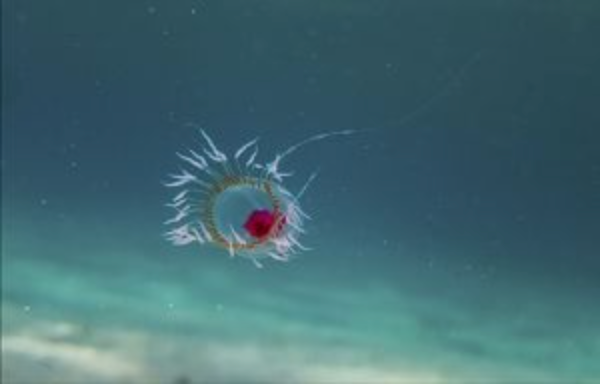
But this week we pause to consider a truly remarkable invertebrate. Meet Turritopsis dohrnii, a jellyfish that is immortal.
Bell of the ball.
A quick clarification on the J-word here. When Aussies hear the word jellyfish, we think of big drifting brutes that ruin a swim at Bondi or lay along the shoreline at high tide. No siree.
Turritopsis dohrnii is a hydrozoan, which makes it a hydromedusa. It is minute. The body, or bell, clocks in at under a half centimetre, think smaller than your smallest fingernail. It contains a vivid red stomach and is fringed by tentacles.
"When you try to kill the jellyfish, it doesn't die" — Associate Professor Maria Pia Miglietta, marine biologist, Texas A&M University at Galveston.
Here is the standard hydrozoan life story.
A larva settles, grows into a colony of polyps, the polyps bud off swimming medusae, the medusae spawn, sag and die. Pretty standard stuff.
But under certain stressful circumstances, Turritopsis dohrnii dodges that last step.
When sufficiently stressed by heat, starvation, foul water, a knife or a needle, the medusa sinks, balls up into a cyst and within a few days reorganises itself into a juvenile polyp carrying the identical genome.
That polyp grows into a colony, the colony buds off fresh medusae, and off we go again.
You cell out.
The technical term for what is happening here is cellular transdifferentiation. It is so cool.
You see, in just about every animal, once a cell makes a career choice, it is stuck with it. If a cell says ‘muscle - yep that’ll work for me’ it stays muscle until it dies. It can’t get bored and switch to being a nerve cell or a gut cell. Yes, you have stem cells, but they are the cells that have not chosen a career path yet. A blood stem cell makes blood and nothing else.
This rule holds for us and countless other animals. (Strictly, it does happen in us occasionally, but it’s rare and it usually means something has gone wrong.)

Turritopsis dohrnii breaks it. As the medusa balls up, the muscle cells in its bell convert directly into other kinds of cell: nerve cells, stinging cells, the cells that make up a polyp.
So no new body is built. The old body is taken apart and its own cells are used again to make the polyp. Nothing is discarded and nothing starts from scratch.
That is what separates cellular transdifferentiation from rebirth. When any other animal reproduces, the parent’s body ends and a new body begins from a single cell. The only thing carried across is the genetic instructions. The parent’s body, and the cells that made them up … all gone.
Here the body never ends. The same cells that were swimming around as an adult are the cells now sitting on the seafloor as a polyp, and later they will be swimming again as multiple new jellyfish.
Ageing is damage piling up in cells that cannot be replaced. This animal replaces them without ever ceasing to exist. There is no moment where it stops and something else starts.
That is why we call this jellyfish immortal.
Immortal combat.
Closer to home, while Turritopsis dohrnii has not been recorded in Australian waters, Turritopsis rubra lives right here, in shallow coastal water off southeastern Australia and Tasmania, most visible over summer between December and March.
And there is fierce discussion in the jellyfish community that TR might also be immortal!

Also, on the I-word the immortality we are observing here is a property of cells, not a measured lifespan. No individual jellyfish has ever been followed forever. Yes, Shin Kubota at Kyoto University's Seto Marine Biological Laboratory hand-fed his colony brine shrimp eggs sliced under a microscope, and reported it rebirthing itself around ten times in two years.
But out in the ocean, something eventually eats you.
And one final reality check. Nobody has ever seen this biological reset happen in the wild. We’ve only ever seen it in a tank.
So we know they can do it. But how often they actually do it, and whether it is a routine part of life out there or a desperate, last resort: we just don’t know.
"The truth is that we need invertebrates but they don't need us" — The legendary biologist E.O. Wilson, quoted by the Guardian in its call for nominations.
Poll position.
In the age of listicles and celebrity insta-slop, it's great to see a publication with the reach of the Guardian celebrating science and the natural world this way.
The last of the top ten invertebrates of the year drops within days, the ballot is open, and the winner is crowned on Monday 17 August. Catch the full list here.
Further Reading:
Piraino, S., Boero, F., Aeschbach, B. & Schmid, V., "Reversing the Life Cycle: Medusae Transforming into Polyps and Cell Transdifferentiation in Turritopsis nutricula (Cnidaria, Hydrozoa)", The Biological Bulletin, 1996. https://doi.org/10.2307/1543022
Stock, P., "'When you kill it, it doesn't die': the jellyfish that has cracked the secret of immortality", The Guardian, 2026. https://www.theguardian.com/environment/2026/aug/04/immortal-jellyfish-invertebrate-of-the-year


Comments